Building Lotsotravel – From a Personal Pain Point to an AI-Powered Global eSIM Store
How a simple side project evolved into a revenue-generating eSIM platform, the unexpected lessons in global markets, and the hurdles of indie e-commerce.
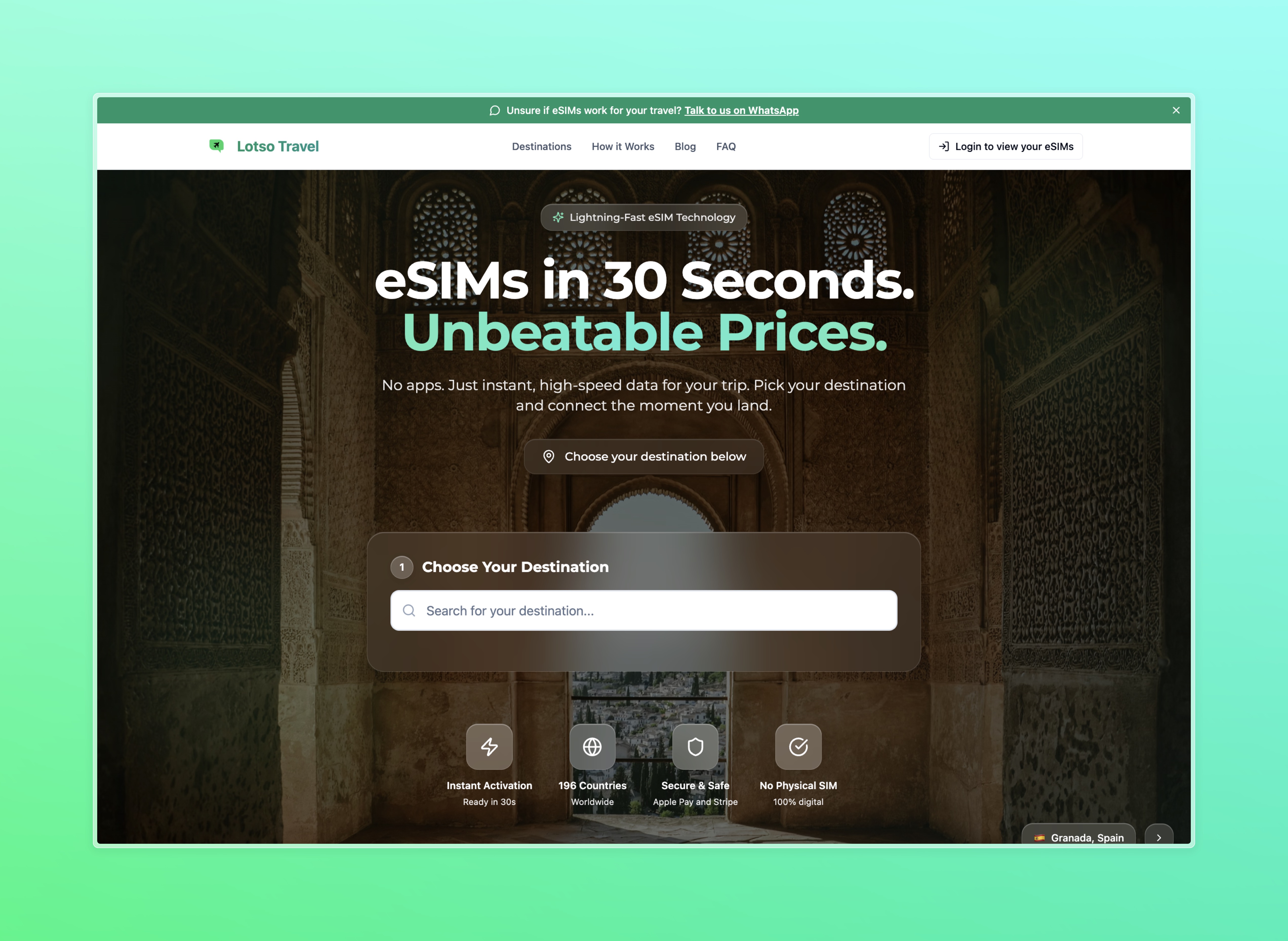
As an engineer and a frequent traveler, there was one problem that consistently annoyed me: the ridiculous cost of international roaming. Every trip felt like a choice between paying extortionate daily carrier fees or wasting the first hour of my vacation hunting down a physical, local SIM card.
Existing eSIM providers existed, but their operations felt bloated, and the costs were still higher than they needed to be. I realized that if I built a highly automated, lean platform, I could dramatically undercut the big players.
That was the genesis of Lotsotravel—a fully automated, AI-first eSIM "convenience store." Here is the journey of how a simple side project evolved into a revenue-generating platform, the unexpected lessons I learned about global markets, and the hurdles of indie e-commerce.
The Catalyst: Lovable Shipped S1
Having an idea is easy; shipping it is the hard part. The forcing function to finally get Lotsotravel off the ground was the Lovable Shipped S1 competition.
I set a hard rule for the build: Automate or Die. I knew I couldn't run a 24/7 support desk while working my day job, so I built an AI-powered automation engine to handle inventory, provisioning, and customer queries, and then wrapped the eSIM business around it.
We launched the MVP during the competition and the response was incredible. Out of over 5,000 international participants, Lotsotravel secured a spot in the Top 10. You can see the winning announcement on the Lovable Shipped S1 Showcase.
More importantly than the accolade, this launch validated the business. We quickly acquired our first 35 paying customers and generated our first $500 in revenue. The system worked, the delivery was instant, and people loved the frictionless checkout.
The Pivot: Finding Our Niche in the South American Market
With initial traction secured, it was time to scale. My initial assumption was straightforward: my customers would be just like my friends and family—North Americans traveling to popular destinations like the US, UK, Switzerland, and Italy.
To increase visibility, Lotsotravel partnered with eSIMDB, a massive independent eSIM comparison platform. This is where the data completely shattered my assumptions.
When the organic sales started rolling in, they weren't for Paris or Rome. They were for Venezuela, Argentina, and Brunei. I was completely baffled until I looked closely at the comparison tools. For popular European corridors, VC-backed giants were locked in a race-to-the-bottom price war. But for the "long-tail," less-frequented destinations, those giants either didn't compete or offered terrible rates. Because Lotsotravel was built on a hyper-efficient, lean automated model, our standard pricing was naturally landing at the #1 most competitive spot for these regions.
We had accidentally captured an underserved niche. I documented this entire realization and the strategic pivot that followed in a popular Reddit post: I was targeting European travellers. My real customers were in Venezuela.
The Dark Side of E-commerce: Scammers and Stripe
Of course, no startup journey is just a clean upward curve. As our visibility on aggregator sites grew, so did unwanted attention.
One of the harshest realities of selling digital goods instantly is dealing with bad actors. We became a target for card testing and fraudulent purchases. When an automated system instantly delivers a product (like a QR code for data), scammers will try to exploit it using stolen credit card information.
Dealing with the subsequent chargebacks and navigating the strict thresholds of payment processors was a massive stress test for the platform's infrastructure. It forced me to rapidly mature our security posture and risk assessment protocols. I wrote a deep dive on this specific, painful lesson on my blog: Stripe is Dangerous.
The Next Chapter: AEO/SEO Growth via Cite-Met
Today, Lotsotravel is stable, secure, and serving a global long-tail market. The current objective is sustainable growth without relying on the massive paid ad budgets that our competitors use.
To do this, we are leaning heavily into the future of search: AEO (Answer Engine Optimization) and SEO. When travelers ask ChatGPT, Perplexity, or Google's AI Overviews for "the cheapest eSIM for Argentina," Lotsotravel needs to be the cited source.
To automate and scale this marketing push, I am "eating my own dog food" by using another one of my projects: Cite-Met. Cite-Met is designed to help brands optimize their digital footprint specifically for AI search engines. By deploying Cite-Met's capabilities, we are systematically positioning Lotsotravel to capture high-intent, organic traffic across the new AI-driven web.
Final Thoughts
Lotsotravel started as a way to fix my own travel bills. It has since become a masterclass in lean architecture, market dynamics, and digital security. It's a testament to the fact that as an indie hacker, your biggest advantage isn't your marketing budget—it's your ability to build efficiently, read the data without ego, and pivot when the market shows you where you truly belong.
Want to try it out? Check out the live project at Lotsotravel.